YANA HAIR BOUTIQUE
1 Day Seamless Hair Extensions Course
1 Day Seamless Hair Extensions Course
Couldn't load pickup availability
1 DAY
SEAMLESS HAIR EXTENSIONS
ONE-DAY INTENSIVE
Installation Masterclass
From Analysis to Perfect Placement — One Day, One Skill, Zero Compromise
|
One Full Day • Hands-On Practice • Certificate of Completion In-Salon Offline Workshop • United States Focus: Installation Only — From Hair Analysis to Flawless Placement |
ABOUT THIS COURSE
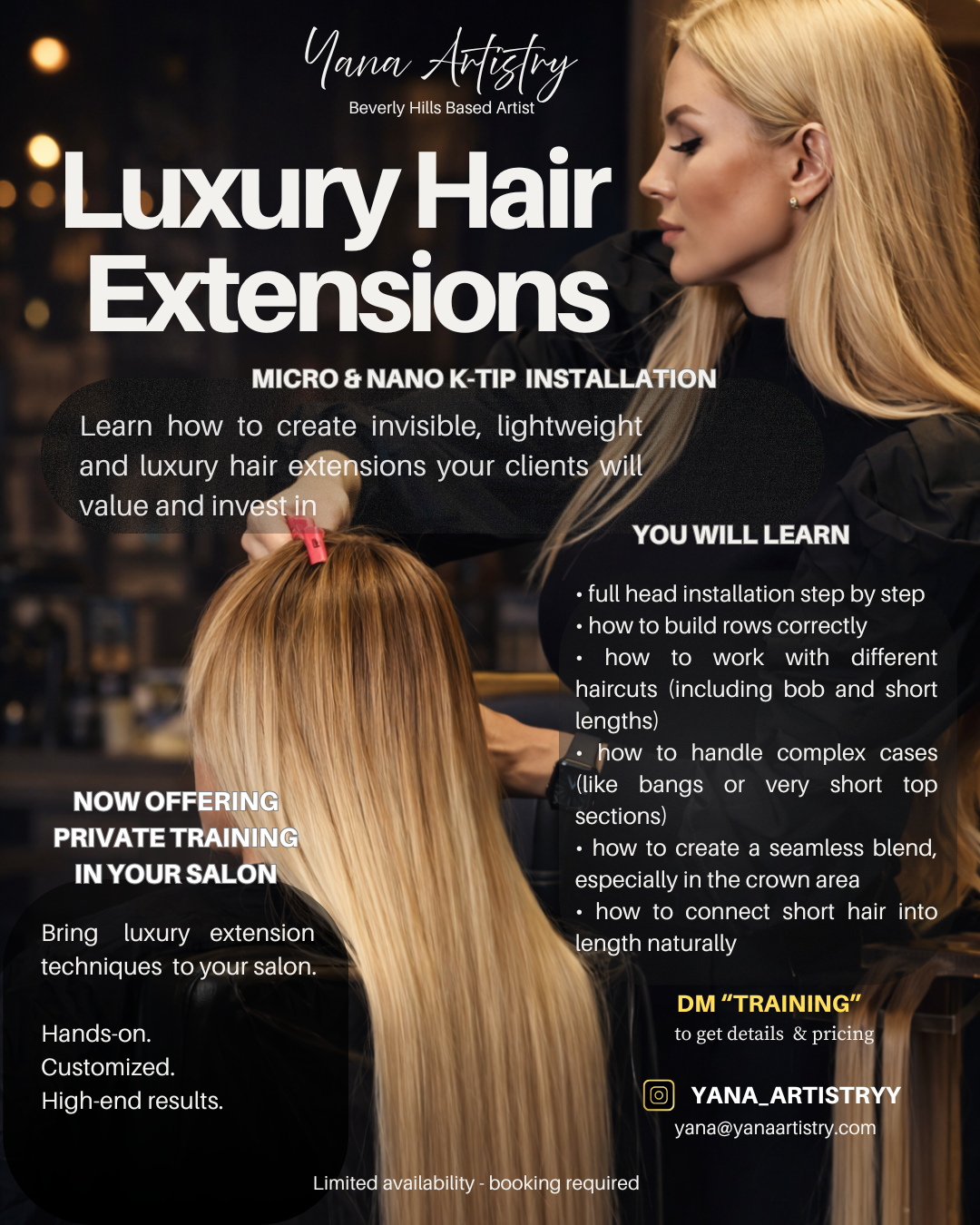
This intensive one-day workshop focuses exclusively on the installation stage of the Micro & Nano Keratin Capsule method. No encapsulation — just the complete science and art of reading each client's hair, selecting the right technique, and executing flawless, undetectable placement.
By the end of the day, you will have worked on a real model and left with a repeatable system you can apply in your salon starting the very next morning.
|
What makes this day different from any extension class you have taken before: |
|
✓ You learn to READ hair — not just apply extensions to it |
|
✓ You learn to SELECT a technique for each specific client case |
|
✓ You practice on real hair, not a mannequin head with perfect conditions |
|
✓ You learn the specialty zones most stylists avoid: temples, crown, fringe, blunt cuts |
|
✓ You leave with a decision-making system — not just muscle memory for one method |
DAY SCHEDULE
|
TIME |
BLOCK |
FOCUS |
|
9:00 – 9:30 |
Welcome & Overview |
Course goals, materials intro, Q&A |
|
9:30 – 10:30 |
Block 1 — Hair & Scalp Analysis |
Structure, density, growth patterns, haircut assessment |
|
10:30 – 11:30 |
Block 2 — Strand Mapping & Sectioning |
Zone mapping, parting systems, row geometry |
|
11:30 – 12:30 |
Block 3 — Angles, Tension & Technique Selection |
Application mechanics, case-based technique matching |
|
12:30 – 1:15 |
Lunch Break |
— |
|
1:15 – 2:30 |
Block 4 — Hands-On Practice: Standard Zones |
Full application on model — back and sides |
|
2:30 – 3:30 |
Block 5 — Specialty Zones (Live Demo + Practice) |
Bang/fringe, temples, crown, blunt cut concealment |
|
3:30 – 4:15 |
Block 6 — Troubleshooting & Refinement |
Common mistakes, corrections, seamless blending checks |
|
4:15 – 5:00 |
Assessment & Certification |
Practical evaluation + Certificate of Completion |
🔍 Block 1 — Hair & Scalp Analysis (9:30 – 10:30)
Before a single strand is placed, you need to understand what you are working with. This block builds the analytical foundation the entire installation depends on.
Hair Structure Analysis
• How to assess hair texture: fine, medium, coarse — and why it changes technique
• Hair density mapping: identifying thick, normal, and sparse zones on the same head
• Natural growth direction patterns and how they dictate strand placement
• Identifying fragile or chemically compromised hair before installation
Haircut Assessment
• How to analyze a blunt cut vs. layered cut vs. textured cut before you plan the installation
• Identifying the density line — where extensions must start to remain invisible
• How to predict where attachment points will show and how to prevent it
• Reading the silhouette: what the final result needs to look like before you start
Client Case Assessment
• How to approach very short hair or heavy breakage throughout the head
• Identifying the correct starting point for thinning crowns and fine hairlines
• Building an installation plan based on the client's specific goal: length, volume, or both
📐 Block 2 — Strand Mapping & Sectioning (10:30 – 11:30)
Precision sectioning is the single most underestimated skill in extension work. Incorrect sections cause visible lines, uneven weight, and poor longevity. This block changes how you part hair permanently.
Zone Mapping
• How to divide the head into working zones before installation begins
• Zone-specific rules: nape, mid-section, crown, perimeter, and transition areas
• How zone placement changes based on client goal — volume vs. length vs. both
• Why the order of zones matters and how to build from the bottom correctly
Section Geometry
• How to create perfectly horizontal, consistent sections every time
• Correct section thickness: the relationship between strand width and capsule size
• Row spacing rules: how far apart rows must be to avoid stacking and bunching
• How to adapt section geometry for different hair densities
Parting Technique
• Hands, tools, and tension: clean parting without disturbing adjacent sections
• How to handle fine or slippery hair that shifts during sectioning
• Clip placement and section holding — keeping the workfield clean
📏 Block 3 — Angles, Tension & Technique Selection (11:30 – 12:30)
This is the decision-making block. You will learn the mechanical rules of placement — and more importantly, how to choose which technique to use based on each specific client case.
Application Mechanics
• Correct angle of attachment: why angle determines comfort, longevity, and visibility
• How to control tension without over-tightening or leaving slack
• Row width selection: narrow vs. wide rows and when each is correct
• How depth of placement (distance from scalp) changes for different zones
Technique Selection by Case
There is no single correct technique — there is the correct technique for this client, today. You will learn to make that call confidently.
|
Technique |
Primary Goal |
Best For |
Why It Works |
|
Cascading Row Method |
Standard length & volume |
Most hair types, all densities |
Provides maximum seamless coverage, ideal starting point |
|
Inverted V-Placement |
Crown & vertex volume |
Thinning top, sparse crown |
Creates natural lift and density from the root area |
|
Micro-Scatter Technique |
Temple & hairline work |
Fine, sparse, or short perimeter |
Smallest capsules, lowest profile, completely invisible |
|
Frame Technique |
Bang & fringe zone |
Any front hairline |
Controls direction and fall of the fringe area precisely |
|
Layered Offset Grid |
Dense / blunt haircuts |
Clients with heavy blunt ends |
Offsets rows to prevent visible lines through thick hair |
|
Perimeter Anchoring |
Short or broken hair |
Grown-out pixie, heavy breakage |
Works from the edges inward, builds structure before fill |
✋ Block 4 — Hands-On Practice: Standard Zones (1:15 – 2:30)
Students work on a live model under direct supervision. This block covers the full installation sequence for the back and side zones — the foundation of every appointment.
✓ Full nape-to-crown installation sequence on live model
✓ Practicing consistent section geometry under real conditions
✓ Applying correct angle and tension with supervised correction
✓ Row-by-row build: spacing, alignment, and symmetry checks
✓ Blending test after each row — catching problems early
Every student receives live feedback at each row. No one moves to the next step until the current one is correct.
🎯 Block 5 — Specialty Zones (2:30 – 3:30)
These are the zones that separate average stylists from specialists. Most extension classes skip them. This block is built around them.
✦ Bang / Fringe Zone
• How to create a natural-looking fringe extension with micro capsules
• Placement direction for fringe that falls correctly and moves naturally.
• How to match the existing hair's movement in the front section
✦ Temple Zone
• Why temples require the smallest capsules available (nano)
• Placement on extremely fine, short, or sparse temple hair
• Angle and depth rules specific to the perimeter hairline
• How to create density at the temples without creating a harsh line
✦ Crown / Vertex Zone
• How to fill thinning crown area with nano capsules invisibly
• Why the crown requires a different approach than the rest of the head
• Placement grid for sparse crown — direction, spacing, and depth
• Avoiding visible attachment points on the top of the head
✦ Blunt Cut / Dense End Concealment
• Why standard placement fails on blunt haircuts and what to do instead
• Offset row strategy to hide attachment through a heavy hair mass
• How to adjust strand width and capsule position for thick, dense ends
• The blending check: confirming invisibility before the client leaves the chair
✦ Short & Broken Hair
• Working with hair too short for standard attachment — building from the perimeter inward
• How micro capsules make extensions possible when most stylists would say no
• Managing mixed lengths on the same head: areas of breakage within longer hair
🔧 Block 6 — Troubleshooting & Refinement (3:30 – 4:15)
✓ How to spot a placement error before it becomes a problem
✓ What visible lines mean and how to correct them immediately
✓ Tension mistakes: too tight, too loose — and how each fails differently
✓ Angle errors and how to identify them by looking at the finished row
✓ Final blending and seamless check: the walkthrough every appointment needs
✓ What to tell the client — explaining the result and setting expectations
WHAT YOU LEAVE WITH
|
After completing this one-day workshop, you will be able to: |
|
✓ Analyze any client's hair and build a precise installation plan before you start |
|
✓ Select the correct placement technique for each specific case — not just one default method |
|
✓ Execute clean, consistent sections on real hair under real salon conditions |
|
✓ Apply extensions at the correct angle and tension in every zone |
|
✓ Work confidently in the temple, crown, fringe, and blunt-cut zones |
|
✓ Identify and correct placement errors during the appointment |
|
✓ Create a result so seamless that no one — including the client — can feel the extensions |
The goal of this day is simple: you should leave more confident, more precise, and ready to offer a level of work your clients have never experienced before.
SEAMLESS HAIR EXTENSIONS — ONE-DAY INSTALLATION MASTERCLASS
Hands-On Offline Training | Certificate of Completion Awarded
Share